Here’s the reality: SaaS sprawl isn’t slowing down. It’s accelerating.
Mid-market IT teams are managing more applications than ever, and most don’t have full visibility into what’s actually running across their environment.
According to recent industry benchmarks, organizations typically overspend 25–30% annually on unused or underutilized IT assets. At the same time, most companies only see about 60% of the SaaS tools actually in use. That gap? That’s where SaaS sprawl lives.
And if you’re running IT for a 500–3,000 employee organization with a team of five or fewer, you already feel it. More renewals. More vendor emails. More shadow tools. More pressure to prove where the budget is going.
Let’s break down what SaaS sprawl really is, and what to do about it.
What is SaaS sprawl?
SaaS sprawl is the uncontrolled growth of SaaS applications across an organization without centralized visibility, ownership, or governance. It’s often the first visible breakdown in a broader SaaS management strategy.
It doesn’t happen because IT is careless. It happens because SaaS is easy to buy.
A marketing manager signs up for a new AI tool on a corporate card.
Finance adopts a niche reporting app.
HR rolls out a new onboarding platform.
Individually, each decision makes sense. Collectively, the environment becomes fragmented.
Healthy SaaS adoption looks like this:
- Centralized discovery
- License tracking
- Usage visibility
- Renewal control
SaaS sprawl looks like this:
- Duplicate tools solving the same problem
- Orphaned licenses after employee offboarding
- Renewal surprises
- Shadow IT that never touches IT’s radar
The real challenge isn’t growth. It’s visibility.
And in hybrid environments, with SaaS, on-prem, and cloud infrastructure interwoven, that visibility gap compounds quickly.
SaaS sprawl by the numbers (2026 snapshot)
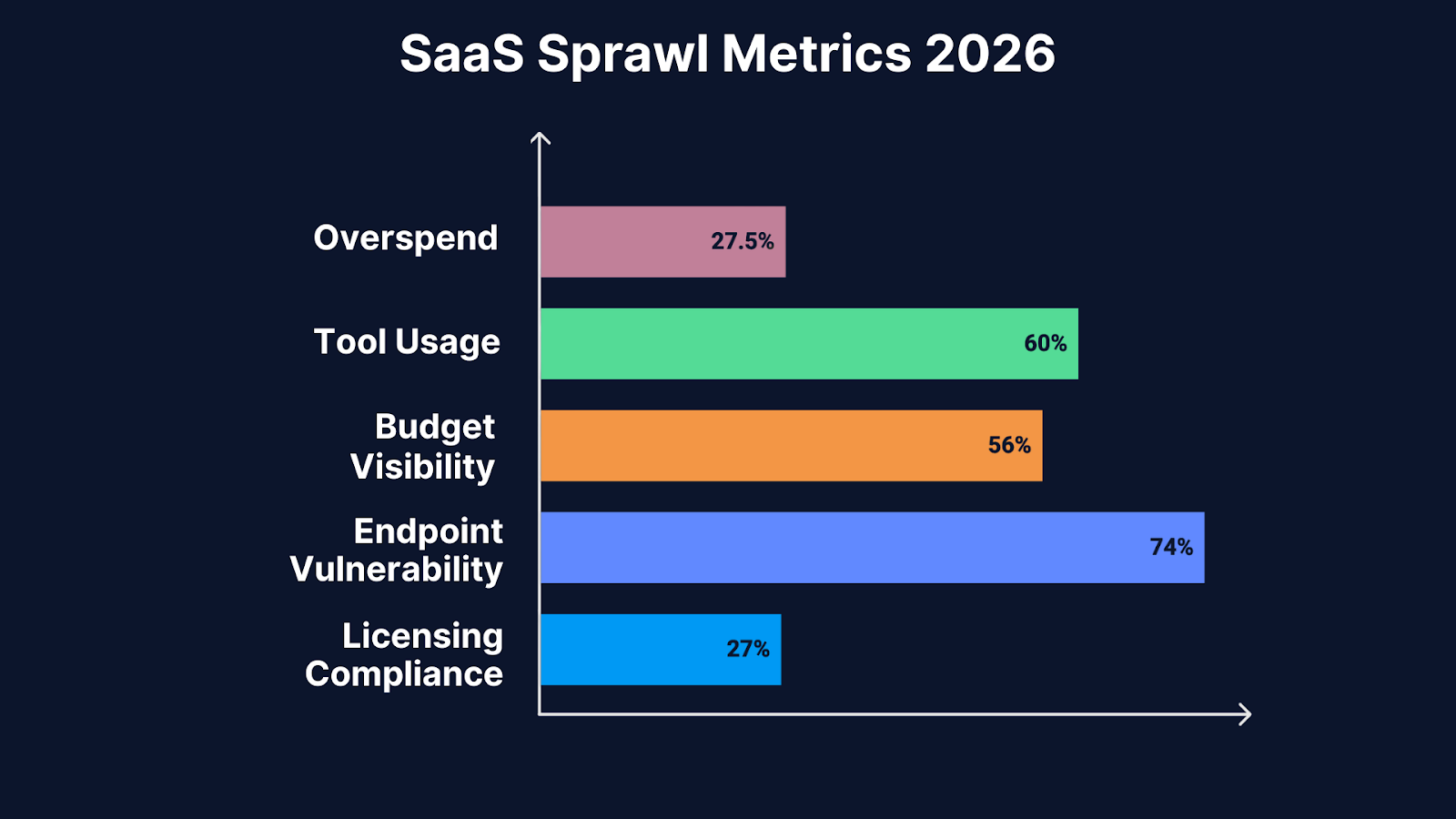
Let’s ground this in data.
- 25–30% average annual overspend on unused or underutilized IT assets (long-standing industry benchmark).
- Organizations typically see only ~60% of SaaS tools in use.
- 56% of IT budgets are tied to assets with limited or no visibility.
- 74% of endpoints have at least one critical vulnerability (CVSS 9.0+).
- 27% of enterprises spend $500K+ annually on licensing compliance issues.
Here’s what that means in practical terms:
If your SaaS environment isn’t continuously discovered and analyzed, you’re likely paying for licenses you don’t need and missing risks you can’t see.
And the problem is getting worse.
SaaS sprawl challenges are multiplying
1. Department-led purchasing is normalized
SaaS vendors optimize for frictionless sign-up. That’s their business model.
IT rarely gets involved at the beginning. By the time it shows up in your environment, the contract is already live.
Most IT teams face this daily.
2. AI tool explosion
The rise of AI-powered SaaS tools has accelerated adoption across every department.
Marketing wants content generation tools.
Sales wants AI prospecting platforms.
Operations wants automation engines.
Each tool adds value. Each tool adds surface area.
Without centralized discovery, SaaS sprawl becomes exponential.
3. Lean IT teams managing hybrid estates
Mid-market IT teams are small by design, often 1–10 staff members managing everything.
You’re handling:
- Endpoints
- Servers
- Licensing
- Cloud infrastructure
- Security posture
- Compliance prep
Adding manual SaaS tracking to that list isn’t realistic.
It becomes spreadsheet management and hope.
4. Vendors changing licensing models constantly
Subscription tiers shift. Bundles change. Terms update.
Let’s be honest about what’s happening: vendors optimize for revenue clarity. IT teams are expected to manually keep up.
That’s not a staffing problem. It’s a tooling problem.
Related reading: Major Software Licensing Changes in 2026: What Mid-Market IT Leaders Need to Know
The real cost of SaaS sprawl
The financial waste is obvious. But it’s not the only issue. The hidden costs of SaaS sprawl compound quietly, across renewals, compliance exposure, security risk, and operational drag
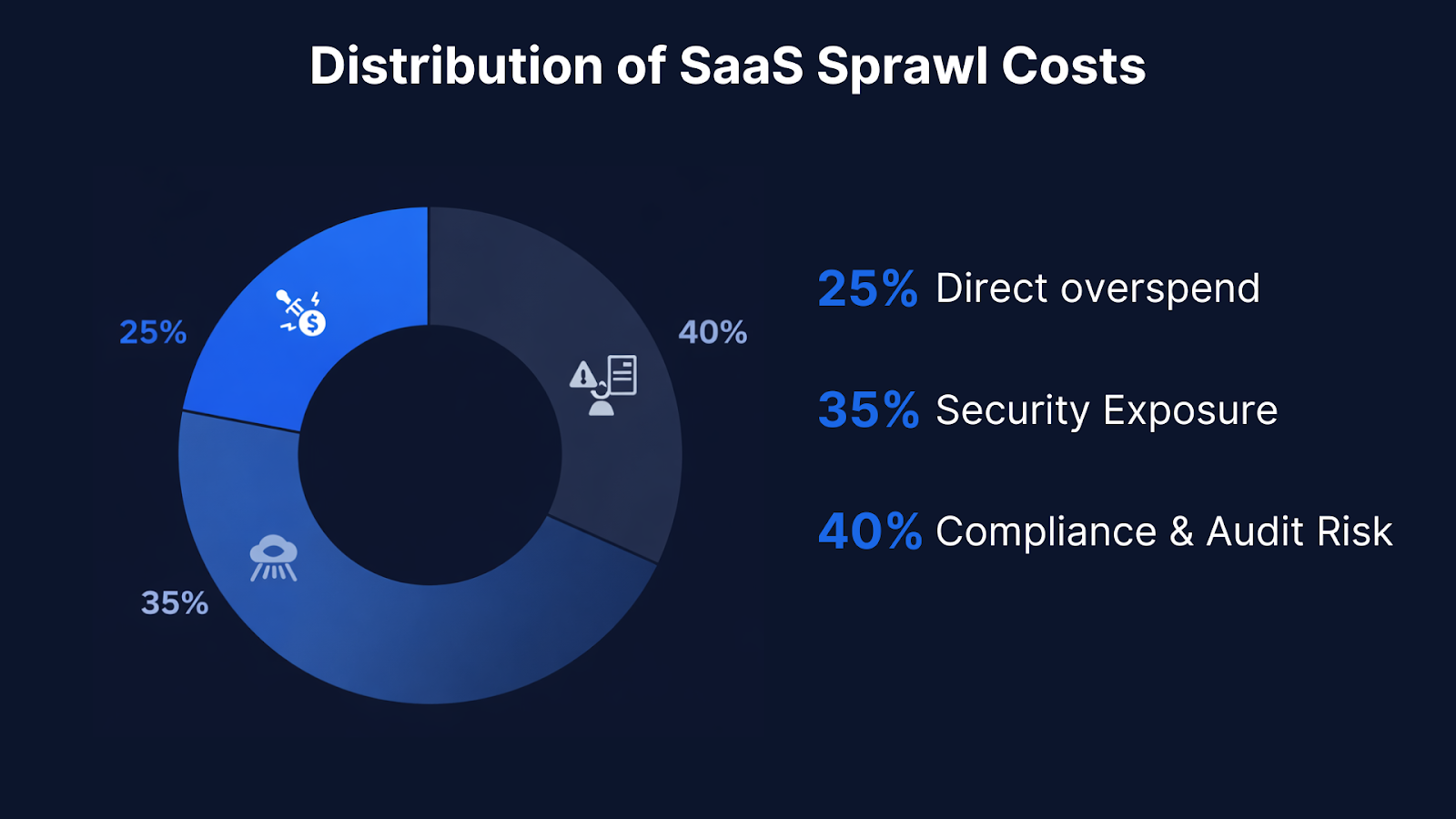
Direct overspend
If you’re overspending 25%, and your SaaS budget is $2M annually, that’s potentially $500,000 in avoidable cost.
And that’s conservative.
In mid-market environments, once full SaaS visibility is established, organizations often uncover significant reclaimable spend — sometimes reaching seven figures annually.
That level of waste doesn’t come from bad teams. It comes from blind spots.
Security exposure
SaaS sprawl creates shadow entry points.
And remember: 74% of endpoints carry at least one critical vulnerability.
If SaaS discovery isn’t continuous, vulnerabilities surface too late.
Block 64 approaches this as proactive security, surfacing vulnerabilities at the discovery layer before they escalate.
Not a vulnerability platform. A visibility platform that catches issues early.
Audit anxiety and compliance risk
Licensing audits aren’t rare anymore. They’re predictable.
And 27% of enterprises report spending $500K+ annually on compliance issues.
Without clear entitlement tracking and usage analysis, audits become defensive instead of prepared.
Related reading: What 500 ITAM Professionals Revealed About Software Licensing
Now that you understand the risk, here’s how to check your environment.
SaaS visibility assessment
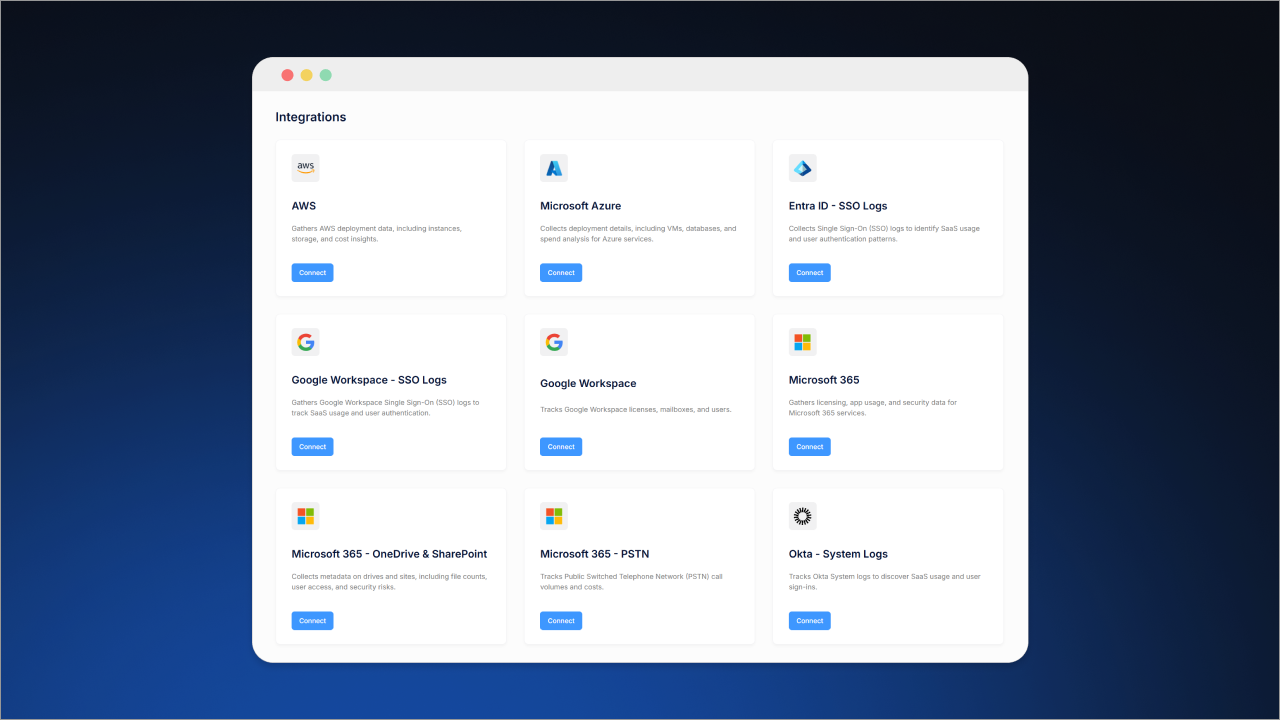
Block 64 scans your environment in 15 minutes and shows you:
- SaaS applications across 18+ major enterprise platforms
- Unused and underutilized licenses
- Renewal exposure
- Vulnerability signals at discovery
- What to prioritize first
No consultants. No six-month implementation.
The SaaS sprawl risk check
Let’s make this practical.
Answer these honestly:
- Can you list every SaaS application in use right now?
- Can you see license count versus actual usage?
- Do you know which licenses are unused or dormant?
- Can you produce a full renewal calendar in under 10 minutes?
- Can leadership see one consolidated IT asset report?
- Can you detect unsanctioned SaaS automatically?
- Do you have entitlement intelligence built into your analysis?
Scoring
- 0–2 “Yes” answers → Controlled environment
- 3–5 → Emerging sprawl
- 6+ → High-risk SaaS sprawl
Most mid-market IT teams land in the middle.
Not because they lack skill. Because their tools were never built for hybrid visibility at this scale.
How to calculate your SaaS sprawl cost
Here’s a simple methodology.
Step 1: Estimate total SaaS spend
Pull annual SaaS subscription costs.
Step 2: Estimate unused percentage
Use 25–30% as a conservative benchmark.
Step 3: Multiply
$2M SaaS spend × 25% = $500,000 potential waste.
Step 4: Add duplicate tool overlap
If two departments use different tools for the same function, factor both.
Step 5: Add compliance exposure buffer
Licensing penalties, renewal misalignment, and audit consulting costs.
Now zoom out.
That’s just direct spend. It doesn’t include:
- Security remediation costs
- Time spent preparing executive reports
- Opportunity cost of IT focus
Inventory alone won’t solve that.
You need intelligence layered on top of discovery.
What to do about SaaS sprawl
You don’t need five new tools. You need one that sees the whole picture.
Here’s where to begin.
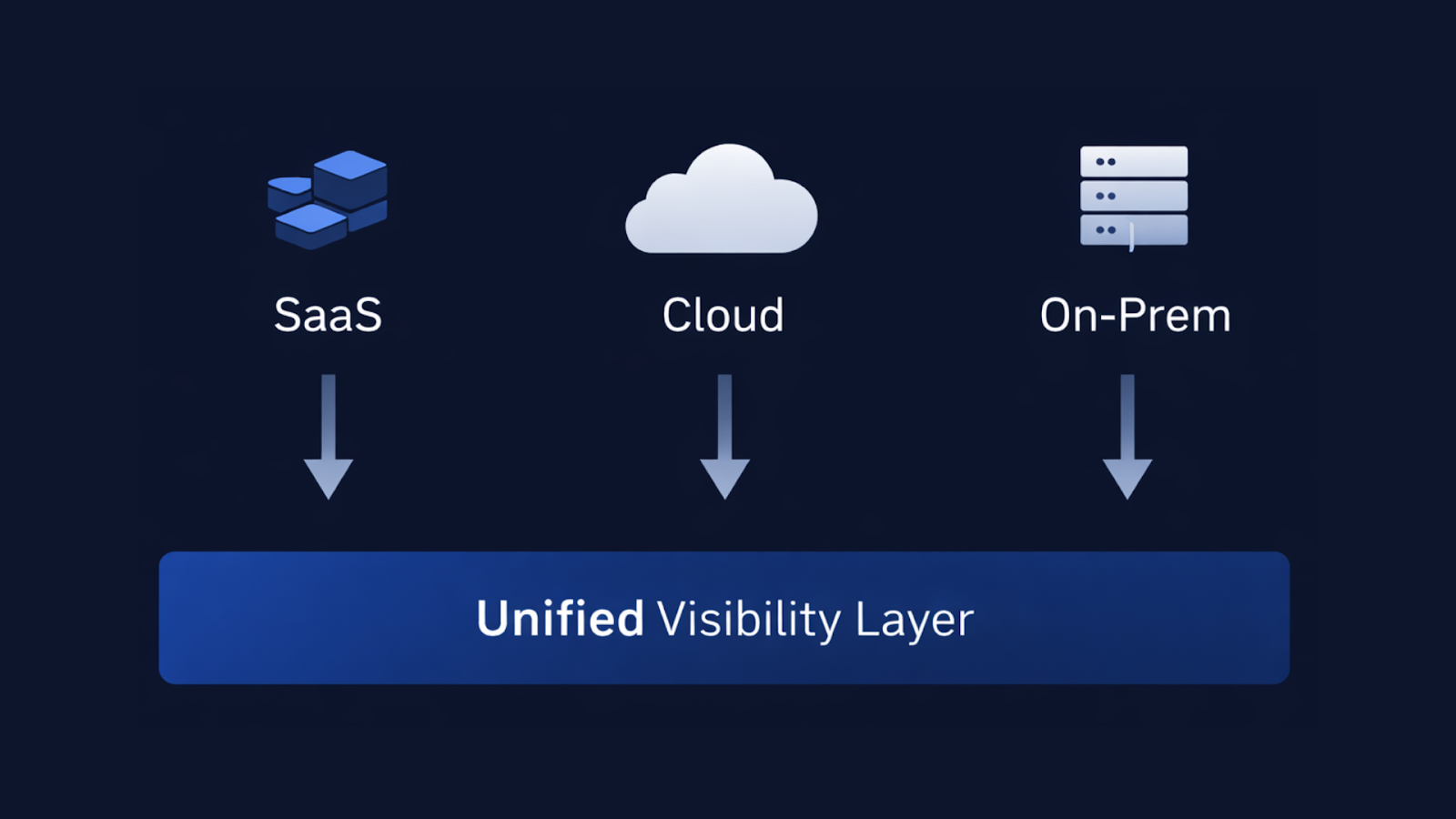
Centralize visibility across SaaS, cloud, and on-prem
Your IT estate isn’t SaaS-only. Or cloud-only.
Fragmented tools create fragmented insight.
Block 64 was built as the Swiss Army Knife of ITAM — SaaS discovery (18+ integrations), cloud visibility, on-prem scanning, entitlement tracking, and vulnerability surfacing in one platform.
Replace inventory with intelligence
Traditional ITAM tools show you what you have.
Modern ITAM tells you what to do about it.
Block 64’s proprietary Software Library interprets licensing rules automatically — embedding consultant-level intelligence directly into the platform.
That’s the difference between a spreadsheet and a strategy.
Deploy fast. Get insight immediately.
Mid-market teams don’t have time for six-month rollouts.
Block 64 deploys in 15 minutes to first insight.
Lunch-hour deployment. End-of-day reporting.
That speed changes how IT conversations happen with leadership.
SaaS sprawl isn’t slowing down
AI adoption will accelerate SaaS growth further.
Budgets will grow — but so will scrutiny.
Security pressure will increase.
The question isn’t whether SaaS will expand.
The question is whether your visibility will keep up.
SaaS sprawl isn’t a discipline problem. It’s a blind spot problem.
Fix the visibility layer. The rest becomes manageable.
Ready to see what’s actually running?
Block 64 gives lean IT teams complete, continuous visibility across SaaS, cloud, and on-prem environments — and tells you exactly what to do about it.
Find Your Hidden Apps — Free Trial