
Most ITAM software buyer’s guides are written for enterprise procurement teams. They assume you have a dedicated Software Asset Management specialist, a six-figure platform budget, and six months to evaluate tools before a single asset gets tracked. That’s not a buyer’s guide. That’s a project plan for a team you don’t have.
If you’re an IT manager responsible for infrastructure, security, operations, and now somehow asset management too, this guide is written for you. It covers why ITAM evaluation has become harder for lean teams, how the market has shifted from traditional inventory tools to unified visibility platforms, and the specific criteria that determine whether an ITAM platform will deliver real operational value or sit unused after go-live.
Why ITAM Evaluation Has Become More Difficult
IT environments have expanded dramatically over the past decade. SaaS applications, cloud infrastructure, and decentralized purchasing models have reshaped how organizations adopt technology, and the asset management challenge has grown with them. Finance leaders expect visibility into software spending. Security teams want to understand where vulnerabilities exist. Procurement teams need to track vendor commitments and licensing obligations. All of these demands depend on having accurate, current information about the organization’s technology assets, and in most mid-market organizations, nobody owns that problem end-to-end.
For organizations with a dedicated ITAM or SAM function, evaluating and implementing asset management platforms is a structured project with defined owners and timelines. But many mid-market organizations don’t have that function. The responsibility falls to infrastructure leads, IT operations managers, or IT directors already managing five other priorities simultaneously. In those environments, most evaluation frameworks fail. Not because good tools don’t exist, but because the frameworks themselves were built for a different buyer.
The market offers many platforms that promise discovery, reporting, and license optimization. The harder task is determining which platform will deliver practical value in a real operational environment, with a lean team, a mixed infrastructure, and no ITAM specialist to run it. Understanding why most evaluations go wrong is the right place to start.
ITAM vs SAM vs Modern IT Visibility Platforms
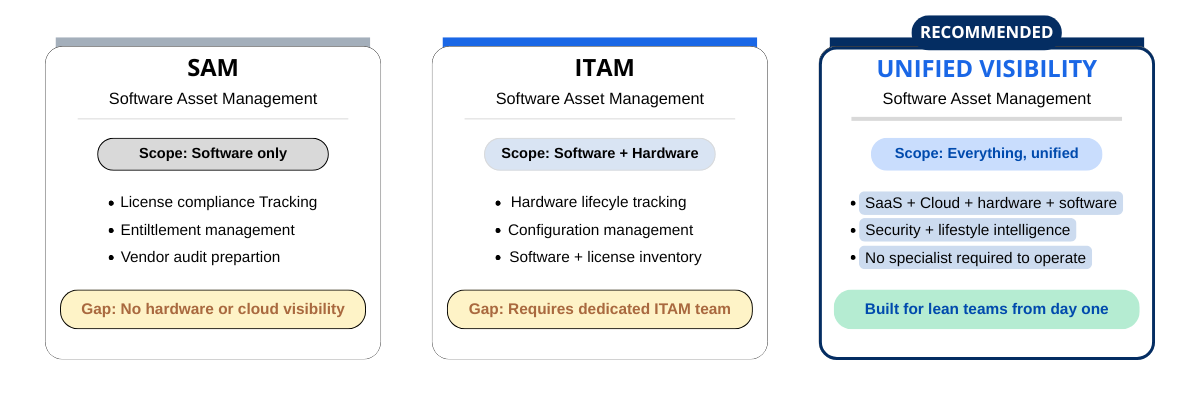
The terminology surrounding asset management tools creates real confusion during evaluation. That confusion often leads teams to evaluate the wrong category of platform entirely. Understanding where each category begins and ends matters before a single vendor demo is scheduled.
Software Asset Management tools focus primarily on software licensing compliance and entitlement tracking. They help organizations interpret vendor agreements, calculate license consumption, and prepare for software audits. They’re valuable, but narrow. They don’t typically provide hardware lifecycle tracking, SaaS sprawl visibility, or infrastructure-level insight. Traditional ITAM platforms expand that scope to include hardware inventory, lifecycle tracking, and configuration management alongside software. They answer the foundational question of what assets exist, but were largely built for environments with dedicated ITAM teams to operate and interpret them.
A newer category has emerged that approaches asset intelligence from a unified visibility model. Rather than treating asset management as a standalone administrative discipline, these platforms connect asset data with operational insights across SaaS, cloud infrastructure, security signals, and financial reporting, all in a single view. For organizations operating in hybrid environments without dedicated ITAM staff, this model is often more practical: it eliminates the need to cross-reference multiple tools to answer a single question about the environment. Block 64 operates in this third category as a unified IT visibility platform that connects SaaS, cloud, hardware, licensing, and security data into one operational view. That distinction matters when evaluating platforms for a lean team, because the operational model is fundamentally different from traditional ITAM.
What Evaluation Actually Looks Like in Practice
When organizations begin evaluating ITAM platforms, the conversation typically starts with feature comparisons. Vendor demonstrations highlight discovery capabilities, license management modules, and reporting dashboards. Comparison articles rank tools by integrations or automation features. But this approach consistently misses the operational reality most IT teams face, and the most common ITAM mistakes follow directly from evaluation processes built around the wrong criteria. Real technology environments are not clean. SaaS applications are purchased directly by departments. Infrastructure spans multiple cloud environments. Licensing data is scattered across spreadsheets, procurement systems, and vendor portals. Security teams maintain their own monitoring platforms while finance tracks software costs through separate systems.
Deploying an ITAM tool does not automatically improve visibility in that environment. The question that matters is whether the platform can deliver meaningful insight within the complexity of your specific environment, and whether your existing team can run it without hiring a specialist. Evaluation criteria for a lean team look different from enterprise criteria. They focus less on feature depth and more on operational usability.
Six Criteria That Determine Whether an ITAM Platform Will Work for Your Team
1. Time to First Value
Many traditional ITAM platforms require substantial deployment effort before producing anything actionable. Integrations must be configured, data normalized, and asset information imported from multiple source systems. For an organization with a dedicated implementation team, that process is manageable. For a lean IT team, it becomes a project that competes with everything else on the queue, and projects that compete with everything else are the ones that never finish. The platform that seemed like the right investment at contract signing delivers no value eighteen months later because deployment stalled at month three.
The standard to hold any platform to is simple: can your team get meaningful asset data out of it before the end of the first week, without outside help? Automated discovery that populates inventory without manual data entry, a setup process a generalist admin can complete independently, and data visible within hours rather than weeks are not premium differentiators. They are baseline requirements for a platform that will actually get used.
2. Hybrid Environment Coverage
Modern IT environments are not clean or centralized. SaaS applications, public cloud workloads, on-premises servers, and physical endpoints frequently coexist within the same organization, often adopted through different procurement paths with no unified tracking in place. SaaS sprawl alone has created visibility gaps that didn’t exist five years ago, and most traditional ITAM platforms weren’t built to close them.
An ITAM platform that covers only one segment of the environment will always produce an incomplete picture. That incompleteness is where cost overruns hide, where security gaps emerge, and where audit exposure accumulates quietly until it doesn’t. A platform that requires separate modules or additional licenses to extend coverage across SaaS, cloud, or hardware is not providing unified visibility. It provides partial visibility with the option to pay for more. For a lean team evaluating platforms, the question is not whether the platform can cover the full environment in theory. It is whether it does so by default, from day one, without incremental cost.
3. Intelligence vs. Inventory
Traditional asset management tools were designed to answer one question: what assets exist? That was sufficient when IT environments were smaller and easier to govern manually. Today, IT leaders need to understand what those assets mean for cost, risk, compliance, and operational continuity. They need that understanding to surface automatically, not assembled by hand from raw data.
A database of assets has limited operational value if your team still has to interpret it manually before it informs a single decision. For lean teams, the distinction between inventory and intelligence is the difference between a platform that changes how work gets done and one that creates a new category of administrative overhead. Platforms that surface proactive alerts on lifecycle status, warranty expiration, unsupported OS versions, and compliance drift, and that prioritize those signals by risk rather than leaving triage to the IT manager, are delivering intelligence. Platforms that produce a comprehensive spreadsheet and call it visibility are delivering inventory. The gap between the two is where most mid-market IT teams spend their time.
4. Licensing Analysis
Major licensing model changes from vendors like Microsoft and VMware have shifted the compliance landscape significantly over the past two years. Software licensing remains one of the most complex areas of IT asset management, and the complexity is accelerating. Organizations typically maintain entitlements across multiple agreements, procurement channels, and contract types simultaneously. In many environments, accurately calculating Effective License Position requires specialized expertise that lean teams simply don’t have on staff.
62% of organizations faced vendor audits in 2024, and that number is climbing. The ability to understand your licensing position and communicate it clearly during an audit, without an external engagement to produce or interpret the analysis, is a core operational requirement. An effective platform should surface automated SaaS license tracking with real utilization data, identify over-licensing and unused entitlements, and produce audit-readiness outputs your team can use directly. If the platform requires a consultant to translate its own reports into a defensible compliance position, it is solving the wrong problem for this buyer.
5. Team Fit
Many ITAM platforms were architected for organizations with dedicated asset management teams: licensing analysts, governance specialists, and ITAM program managers. The workflows, interfaces, and operational models reflect that assumption deeply. For a generalist IT team, a platform built on that assumption is not a tool. It’s a dependency on a role that doesn’t exist in your organization.
Before selecting a platform, the right question is not what the platform can do in a controlled demo environment. It is who on your current team can realistically own it day-to-day, without a specialist hire or a certification program standing between them and productive use. Platforms that require ITAM expertise to operate shift the cost of the tool from the subscription line to the headcount line. For most mid-market IT teams, that is a hidden cost that doesn’t show up until after go-live.
6. Pricing Transparency
Enterprise ITAM platforms are typically priced by managed devices, seats, or modules. These structures escalate in ways that aren’t always visible at signing. Organizations often discover mid-contract that expanding coverage to a new infrastructure domain requires an additional license tier that wasn’t in the original budget conversation. Newer platforms have moved toward employee-based or per-user pricing that scales predictably, removing the incentive to under-report assets in order to contain license costs. Total cost of ownership includes deployment effort, ongoing administration, and module expansion, not just the headline subscription price, and all three should be calculable before a contract is signed. Before committing, confirm the answers to three specific questions:
- Does the pricing structure penalize expanded asset coverage or environmental growth?
- Are there hidden module costs for SaaS management, security integration, or cloud visibility?
- Can your team calculate the total cost without a sales conversation to unlock the numbers?
Where Enterprise Platforms Genuinely Excel
To be direct: if your organization is deploying ITAM across tens of thousands of endpoints, with dedicated ITAM professionals, complex SAP license reconciliation, and multi-vendor enterprise agreements, platforms like ServiceNow HAM Pro, Flexera, or Snow Software will offer capabilities that mid-market solutions cannot match. Their depth in mainframe asset management, large-scale software audit defense, and native integration with enterprise ITSM ecosystems reflects years of development for a specific buyer profile. For that buyer, the investment and implementation complexity are justified.
The honest question is whether your organization is that buyer. For most mid-market IT teams managing hybrid environments of a few hundred to a few thousand devices without a dedicated ITAM function, the answer is no. Selecting a platform built for that buyer means inheriting implementation complexity, operational overhead, and cost structures your team was never sized to absorb.
Why Block 64 Is Built for This Buyer
Block 64 was designed around the criteria above, not as a stripped-down version of an enterprise platform, but as a purpose-built IT visibility solution for organizations that need comprehensive asset intelligence without a full-time ITAM function to run it. The platform delivers a centralized view across hardware, software, SaaS, and cloud through a single Insights Report, giving IT leaders a real-time picture of the entire estate without stitching together separate tools or maintaining manual spreadsheets alongside the platform. The fragmented data problem that makes most IT environments difficult to govern doesn’t get patched. It gets eliminated.
That outcome is not theoretical. E78 Partners used Block 64 to achieve full IT visibility and measurable cost savings across their client environments, demonstrating what the platform delivers when a lean team has the right visibility infrastructure in place.
Where Block 64 differs most meaningfully from traditional ITAM tools is in what it does with that data. The platform proactively surfaces unsupported OS versions, outdated software, expiring hardware warranties, and endpoint vulnerabilities, enabling IT leaders to move from reactive firefighting to planned lifecycle management. For lean teams, that shift produces measurable operational change: fewer emergency responses, better budget predictability, and a defensible risk posture when leadership asks about infrastructure exposure.
On the licensing side, Block 64 handles SaaS licensing, identity governance, cloud cost tracking, and security posture reporting in a way that allows IT managers to identify inefficiencies, governance gaps, and compliance risks without an external engagement. Research into what 500 ITAM professionals revealed about software licensing chaos makes clear how widespread the problem is across mid-market environments. Block 64 is built to resolve it at the platform level, not push it downstream to a consultant.
The security integration is worth noting separately. Block 64 correlates asset data with vulnerability and security reporting, giving IT leaders a unified view of where lifecycle status intersects with security exposure. The assets that are end-of-life and carrying active vulnerabilities simultaneously represent the highest-priority remediation targets in any environment. Block 64 surfaces them automatically. Cloud, Compute, and custom assessment reports then translate that intelligence into executive-ready outputs that support leadership conversations around cost optimization, risk posture, and infrastructure planning, without requiring a separate reporting layer to do so.
Questions to Ask in Every ITAM Platform Demo
The answers to these questions, and a vendor’s willingness to answer them directly without deferring to a follow-up call, will tell you more about operational fit than any feature comparison matrix.
- How long does initial asset discovery take from deployment? Are professional services required to get started, and if so, at what cost?
- Can you show me what the inventory looks like 24 hours after installation, before any manual configuration has been done?
- Does the platform support SaaS, on-premises, cloud, and hardware in a unified view, or are these separate modules with separate activation costs?
- How does the platform surface actionable recommendations vs. requiring my team to manually interpret raw data before it becomes useful?
- Walk me through a license compliance report. Could my team present this in a vendor audit without outside help to interpret it?
- What does pricing look like as my environment grows? Are there per-device, per-module, or per-integration costs that escalate with scale?
- What does a typical implementation look like for a team of our size, without a dedicated ITAM specialist on staff?
- How does the platform connect asset lifecycle data with security vulnerability information, and what does that output look like?
The Bottom Line
Evaluating ITAM software without a dedicated ITAM team is no longer an edge case. It is the standard condition for most mid-market IT organizations. The demand for platforms that deliver real-time visibility, lifecycle intelligence, and operational integration continues to grow as environments become more distributed and more complex. Asset tracking alone stopped being sufficient years ago. What organizations need now is asset intelligence: data that is connected, interpreted, and surfaced in a form that supports decisions rather than requiring decisions just to process it.
The platforms built for lean teams are not the ones described in enterprise procurement guides. They are built from the beginning around a different operational model, one where the IT manager running the platform is the same person managing the infrastructure, the security posture, and the quarterly budget conversation with leadership. That buyer needs a platform that starts delivering value in the first week, scales without surprise costs, and doesn’t require a specialist to extract insight from it. Understanding the full scope of what modern ITAM visibility requires is the right foundation for making that evaluation well.
If you’re evaluating ITAM software in 2026, the criteria in this guide are the right place to start. The best platform for your organization is not the most powerful one on the market. It’s the one your team will actually use, and that your leadership will actually see results from.
Ready to see what ITAM visibility looks like in practice? Start your free trial and get full visibility across your environment in days, not months.