Introduction: The SaaS Explosion and What It Means for IT
A decade ago, enterprise software purchases were centralized, deliberate, and governed by IT procurement processes that moved slowly by design. Today, software adoption looks almost nothing like that.
Teams experiment with new tools on their own initiative. Vendors launch products weekly. Cloud-based applications and AI add-ons can be trialed, purchased, and deployed with almost no friction, and in many cases without IT knowing it happened.
For mid-market IT teams, that shift has created real benefits and real problems in roughly equal measure. Modern organizations routinely depend on hundreds of SaaS applications to keep daily operations running. Marketing teams subscribe to analytics platforms. Finance teams deploy automation tools. HR teams adopt onboarding systems. Developers integrate collaboration software. Each tool may solve a real problem, but together, without any coordinating structure, they create an environment that is genuinely difficult to monitor, secure, and optimize.
The challenge is not simply the number of applications. It is the absence of coherent visibility across all of them at the same time.
SaaS management has emerged as the discipline built to address this directly. Rather than treating software subscriptions as isolated purchases to be tracked in a spreadsheet, SaaS management treats the entire software environment as a lifecycle that must be continuously discovered, governed, and optimized. Industry studies consistently put the average mid-market SaaS stack somewhere between 130 and 500 applications, with 25 to 30 percent of total spend going to licenses that go largely unused. More striking is how much of that stack sits outside IT’s direct visibility. In some environments, up to 40 percent of applications were never formally approved or reviewed. This guide covers every phase of the management lifecycle required to close those gaps.
What Is SaaS Management?
SaaS management is the structured, ongoing oversight of every cloud-based software application used across an organization. It covers discovering what applications exist, monitoring how they are actually used, managing what they cost, enforcing the governance policies that keep the environment secure, and ensuring that contract renewals are handled deliberately rather than by default.
In practice, SaaS management sits at the intersection of several IT disciplines: procurement, security oversight, asset management, and financial planning. The goal is not simply to keep a running list of software purchases. The goal is to understand how software is used across the organization, how much genuine value each tool delivers, and whether the overall software environment is operating efficiently relative to what the business actually needs.
For many mid-market companies, SaaS adoption grew faster than any governance process could keep up with. Early adoption often started with a small number of productivity tools. Over time, departments added new platforms independently to solve immediate operational problems. Because SaaS tools are easy to purchase and even easier to deploy, many of those decisions happened entirely outside traditional IT processes. Not out of bad intent, but because the friction of going through IT simply seemed unnecessary when a monthly subscription could be started with a credit card.
The result is that IT teams frequently inherit environments where application ownership is unclear, subscription costs are fragmented across dozens of department budgets, and no reliable utilization data exists. SaaS management addresses this by establishing a lifecycle framework that transforms reactive, ad hoc software oversight into a proactive, continuously improving operational discipline.
Why SaaS Management Has Become Critical
The urgency around SaaS management is not the result of a single technology shift. It has accumulated from several structural changes in how organizations adopt and use software, all of which converged over roughly the same decade.
The most obvious driver is sheer scale. Mid-market companies routinely operate between 130 and 500 SaaS applications, and most IT leaders discover when they first conduct a genuine discovery audit that their actual count is significantly higher than their working estimate. That gap between assumed and actual scale is one of the most common and most expensive surprises in IT operations.
Alongside scale, purchasing authority has become far more decentralized. SaaS vendors now increasingly sell directly to department leaders rather than to IT procurement teams. A marketing director subscribes to a new analytics platform. An operations manager signs up for workflow automation. Each decision may be entirely rational on its own terms, but collectively they create a fragmented software environment that no single team has full visibility into, and no single team feels fully responsible for managing.
Security and compliance expectations have intensified at the same time. Every SaaS application introduces potential access risks, data governance concerns, and integration dependencies. Without centralized visibility, organizations can unknowingly expose sensitive customer or financial data through unvetted software platforms. Regulatory frameworks, including SOC 2, ISO 27001, GDPR, and HIPAA, increasingly require organizations to demonstrate clear, documented oversight of their vendor relationships. That standard is very difficult to meet when a meaningful portion of the vendor landscape is invisible to IT.
Financial pressure has sharpened the stakes considerably. SaaS subscriptions renew automatically, and vendors adjust pricing structures far more frequently than traditional software vendors ever did. An organization that signed a 500-seat contract two years ago may find at renewal that the vendor has restructured its tiers, added a new “enterprise” feature set to justify a price increase, or simply raised rates, assuming the customer will not bother to push back.
When organizations lack renewal oversight or license utilization data, they have no leverage in that conversation and no basis to push back. They accept the invoice. Across a portfolio of 150 applications, that pattern of passive renewal compounds into a significant and largely invisible budget problem — one that tends to surface only when a CFO notices a line item and starts asking questions nobody is prepared to answer.
Mid-market organizations are particularly exposed to all four of these dynamics simultaneously. Unlike large enterprises, mid-market IT teams typically operate without a dedicated procurement function, yet their SaaS footprint often rivals that of organizations several times their size. That gap between scale and resources is precisely where unmanaged SaaS does its most serious damage, and where a structured management program tends to show returns faster than almost any other IT investment.
Consider what this looks like in practice. A six-person IT team supporting 220 employees runs a SaaS stack of around 180 applications (a number they would have estimated at maybe 90 before they actually counted). Renewals are scattered across eleven different department budgets. Three teams are paying separately for tools that do the same thing. The CFO asks why software spend is up 22 percent year over year. Nobody on the IT team can answer that question from a single system. They spend three days assembling the answer from finance exports, email threads, and vendor invoices. Even then, it is incomplete. That is not an edge case. It is the default operating state for a significant portion of mid-market IT organizations, and it is exactly the problem SaaS management is built to solve.
The SaaS Management Lifecycle: Four Core Phases
Effective SaaS management follows a lifecycle model that mirrors how software is actually adopted and used inside organizations. Most mature programs are built around four interconnected phases: discovery, optimization, governance, and renewal management. Each phase addresses a different layer of operational challenge. The phases are sequential in the sense that you need discovery before you can optimize, but in practice, they run in parallel once a program is established.
Phase 1: SaaS Discovery
Discovery is the foundation on which everything else depends, and it is consistently where organizations find the most immediate surprises. Using a tool like Block 64's unified visibility platform, SaaS discovery builds a comprehensive, continuously updated inventory of every application in use across the organization. Not just the tools IT approved and manages, but everything employees are actually using to get their work done.
Most organizations begin a SaaS management initiative with roughly the same experience: a realization that their actual application count is substantially higher than anyone’s working estimate. Discovery typically surfaces shadow IT (applications adopted without formal IT approval), redundant tools serving the same function across different departments, subscriptions that were never formally cancelled, and trial accounts that quietly evolved into long-term commitments. The practical implication is that meaningful optimization or governance is impossible until the inventory is honest.
How Discovery Actually Works
The most reliable approach combines several data sources in parallel:
- Identity Provider Audit (Okta, Azure AD, Google Workspace): surfaces every sanctioned application connected via SAML or OAuth.
- Financial Data Mining (corporate cards and accounts payable): captures paid subscriptions that exist outside IT’s formal portfolio.
- DNS and Proxy Log Analysis: reveals tools employees use day-to-day that never appear in any official system.
- Department Surveys: fills in freemium tools, trials, and departmental self-serve apps that generate no financial footprint.
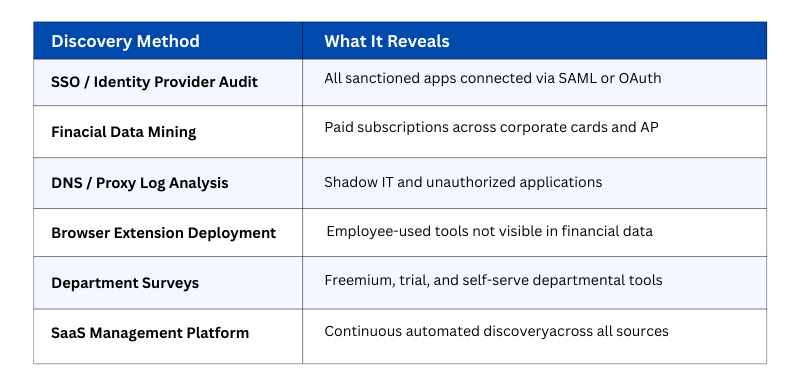
Purpose-built SaaS management platforms automate the combination of all these signals into a continuous, near-real-time inventory. For organizations managing more than 75 to 100 applications, that automation level quickly becomes necessary to maintain accuracy.Once discovered, every application needs to be catalogued consistently enough to be useful. The minimum useful record for each application includes the vendor name, primary business owner, active license count versus actual user count, annual contract value and renewal date, security certification status, SSO and MFA enrollment, data classification (public, internal, confidential, or regulated), and a business criticality rating. Without those fields standardized across the inventory, the downstream analysis that drives optimization and governance decisions becomes unreliable.
Shadow IT Deserves Specific Attention
Shadow IT carries compounding risk in a way that makes it worth treating separately from the broader discovery problem. Applications adopted outside IT processes are not subject to vendor security reviews, do not enforce SSO authentication, and fall outside any data governance framework the organization has built. A single shadow IT application storing customer records in a non-compliant environment can create meaningful legal and regulatory exposure, and the organization may have no way of knowing until a breach or audit surfaces it.
The right framing for shadow IT is not that employees are doing something wrong. Most shadow IT emerges because the official IT procurement process is perceived as slow, and departments have real problems to solve. Discovery gives IT the information needed to respond to that situation deliberately: sanctioning the tools that are genuinely valuable, replacing the ones that are not, and establishing a governance process fast enough that employees do not feel the need to work around it.
Phase 2: SaaS Optimization
With a complete and honest inventory established, the optimization phase focuses on a more targeted question: of the applications we know we have, which ones are delivering genuine value for what we’re paying, and where is money being spent on something the organization has effectively stopped needing?
License Right-Sizing
License right-sizing is the process of aligning purchased seat counts with actual utilization. Most mid-market organizations overprovision by 20 to 30 percent, paying month after month for seats that go unused. The mechanism that drives this is straightforward: teams estimate license needs at the point of purchase, procurement rounds up to the nearest tier, employees change roles or leave, and nobody formally reclaims those seats. Multiply that pattern across 150 applications, and the accumulated waste is substantial.
Addressing it requires sustained usage monitoring: tracking login frequency and feature engagement per seat over a rolling 90-day window, automatically flagging accounts with no activity for 30 or more days, and reviewing whether users on premium tiers are actually using the features that justify the premium. For tools where concurrent usage is consistently low, governed shared-access pools can reduce seat counts significantly without a meaningful impact on the people doing the work.
Application Rationalization
The average mid-market SaaS stack contains three to five redundant application categories, where multiple teams have independently purchased tools that serve the same basic function. Project management, file storage, internal communication, e-signature, and HR workflow tools are the most common overlaps. Rationalization means surfacing those redundancies explicitly, modeling the cost of consolidation against the switching costs and migration complexity, and building a prioritized roadmap that moves the organization toward a cleaner, lower-cost stack over a realistic time horizon. The key discipline is presenting that analysis to stakeholders with a phased transition plan rather than a sudden mandate, which tends to generate resistance that stalls the program.
Vendor Negotiation
Mid-market companies consistently underestimate the negotiating leverage they hold, particularly at renewal time. The instinct is often to accept the renewal invoice as a given, but vendors expect to negotiate, and the organizations that engage deliberately tend to come out significantly better. Engaging 90 to 120 days before renewal creates enough runway to evaluate alternatives and signal credibly that the business is willing to switch. Presenting actual utilization data gives the conversation a factual basis that is difficult for a vendor to dismiss. Identifying two or three genuine competing alternatives and referencing them specifically, not just in the abstract, changes the dynamic of the conversation. And offering a multi-year commitment in exchange for a per-seat discount is a lever that works reliably when the organization’s intent to stay is genuine.
In many environments, organizations that apply these practices systematically find they recover meaningful budget in the first year — often in the range of $1,000 to $5,000 per employee, though the number varies significantly depending on how unmanaged the environment was to begin with. For a 200-person organization that has never run a formal SaaS program, it is not unusual to find $200,000 or more in recoverable spend — not by eliminating tools teams depend on, but by reclaiming licenses that stopped being used and renegotiating contracts with better information than the vendor expected.
Phase 3: SaaS Governance
Governance is the layer that transforms discovery and optimization from periodic exercises into a sustainable, ongoing capability. Without governance, every improvement made during the first two phases begins eroding the moment the next department head subscribes to a new tool without telling IT. Governance is the set of policies, processes, and ownership structures that prevent that erosion.
Procurement Policy
A formal SaaS procurement policy defines who can authorize software purchases, what approval workflows apply at different spending levels, and what security standards vendors must meet before they join the approved stack. In practice, the policy needs to be clear enough to be followed consistently and fast enough that teams do not route around it. A policy that requires six weeks of review for a $50/month tool will generate shadow IT, not compliance.
The most functional policies establish spending thresholds that map to realistic approval tiers: manager approval for tools under a defined monthly threshold, IT and Finance involvement above it, and legal review for contracts above an annual value floor. They require SOC 2 Type II certification (or equivalent) for any application that handles customer or regulated data. They mandate SSO integration with the organization’s identity provider as a condition of approval. And they establish a data classification review as a standard step for any tool that will store confidential information, so that data governance decisions are made before a vendor is onboarded, rather than discovered after.
Vendor Security Review Tiers: User Lifecycle Management

Unmanaged user offboarding is one of the most consistent sources of both security risk and license waste in mid-market environments. When an employee leaves and their SaaS access is not revoked promptly, or at all, the organization is paying for a seat that no longer serves any business purpose while keeping a live credential open in every system that the employee could access. In environments where offboarding is handled manually, those credentials routinely persist for months.
The standard framework for addressing this is structured around three personnel transitions: joiners, movers, and leavers. When someone joins the organization, role-appropriate tool access should be provisioned on day one, driven by their role in the HRIS system rather than by an IT ticket someone might or might not file. When someone moves departments or changes titles, access permissions adjust to reflect the new role. When someone leaves, all SaaS access is revoked, and licenses are reclaimed immediately, triggered automatically by the termination record in the HRIS, not dependent on a manager remembering to submit a request. Connecting your HR system (Workday, BambooHR, or equivalent) directly to your identity provider is the infrastructure investment that makes all three of those transitions reliable at scale.
Phase 4: SaaS Renewal Management
Renewal management is the phase where the financial return on a SaaS management program becomes most tangible and most measurable. In an unmanaged environment, contracts auto-renew at full price with no review, no license right-sizing, and no negotiation. Across a portfolio of 100 or more applications, the cumulative cost of that pattern is substantial. Organizations that implement deliberate renewal management recover that value systematically.
The Renewal Calendar
The starting point is centralizing all contract renewal dates into a single system: your SaaS management platform, your procurement tool, or a rigorously maintained shared calendar. The specific system matters less than the discipline of triggering a structured review workflow 90 to 120 days before each contract end date, which is the window that creates meaningful negotiation leverage.
That workflow follows a consistent sequence:
- Pull the last 90 days of license utilization data.
- Talk to the business owner: is this tool actively used and still genuinely necessary?
- Run a cost-benefit analysis against current usage patterns and projected future need.
- Open vendor negotiations at the 60-day mark.
- Reach a final decision (renew, downsize, migrate, or cancel) with enough time to execute before auto-renewal triggers.
The cadence feels administrative, but running it consistently is what separates organizations that control their SaaS costs from those that simply accept whatever the vendor invoices.
Renewal Evaluation Criteria
SaaS Management vs. IT Asset Management
Many organizations initially evaluate SaaS management tools as point solutions, specifically platforms that focus on cloud application visibility. That framing is reasonable, but it reflects only part of the operational picture most mid-market IT teams are actually working with.
Most mid-market organizations do not run pure SaaS environments. They operate hybrid environments that combine cloud applications with on-premise infrastructure, cloud platforms like AWS or Azure, and a fleet of managed endpoint devices. Managing those layers in separate silos creates fragmented visibility that makes strategic decision-making harder than it needs to be.
Where ITAM Visibility Goes Further
IT Asset Management (ITAM) platforms address this by integrating SaaS monitoring with broader infrastructure visibility. Rather than tracking cloud applications in isolation, an ITAM platform consolidates hardware assets, traditional software licenses, cloud services, and SaaS tools into a single operational view. For IT leaders who need to understand how software costs interact with infrastructure spend, how security controls apply across the full environment, and how the total technology budget maps to business value. The unified visibility that ITAM provides can be substantially more useful than a standalone SaaS tool, even if the SaaS-specific feature depth is sometimes shallower.
How to Decide Which Fits Your Environment
The practical decision rule is more specific than “it depends.” A standalone SaaS management tool is typically the right starting point when the environment is predominantly cloud-based, when the primary problems are license waste and shadow IT, and when the IT team is small enough that adding another platform to manage would itself create overhead. In that context, a focused SaaS tool delivers fast, measurable returns without requiring a larger organizational change. The calculus shifts when the environment is genuinely hybrid: when on-premise infrastructure, endpoint management, and cloud platforms are all material parts of the IT footprint and are currently managed through separate, disconnected systems. At that point, the fragmentation tax of running siloed tools often exceeds the cost of consolidating into a platform that provides unified visibility across the full estate. The signal to watch for is not the size of the SaaS stack in isolation, but whether IT leadership is regularly unable to answer basic cross-domain questions: how a particular SaaS application interacts with on-premise identity infrastructure, where a specific dataset actually lives across the vendor landscape, or what the total cost of a business capability looks like when SaaS subscriptions, infrastructure, and support overhead are considered together. When those questions cannot be answered without assembling data from three different systems, unified IT visibility has become the more pressing need.
Platforms like Block 64 are built specifically for that context: organizations that have outgrown point solutions and need a single operational view across SaaS, hardware, and infrastructure without the implementation complexity that enterprise ITAM platforms typically carry.
How to Evaluate SaaS Management Software
As SaaS environments grow more complex, manual tracking becomes unreliable in ways that compound quietly over time. Spreadsheets and departmental documentation may capture a workable slice of the environment, but they rarely provide a complete or current view of a 100+ application stack. The gaps tend to cluster around exactly the tools where oversight matters most.
Purpose-built SaaS management software addresses this by centralizing visibility and automating the operational workflows this guide has described. The market has matured significantly, and platforms vary considerably in their depth, focus, and fit for different organizational contexts. Evaluating them well means understanding both what to look for in any platform and how to think about the different vendor categories.
Try out Block 64's end-to-end ITAM and SaaS Management platform free - no credit card needed.
Core Capabilities That Separate Platforms
Discovery accuracy is the most important single capability to evaluate, and the one that is hardest to assess from a demo. A platform that provides deep discovery, surfacing 95 percent of the actual stack with reliable usage data, is worth more than one with a more polished interface built on incomplete visibility. Testing discovery in a proof-of-concept against the real environment, rather than accepting vendor claims at face value, is the most reliable evaluation method.
Beyond discovery, the capabilities that tend to differentiate platforms in practice are: usage analytics with configurable time windows and per-user detail; license management with real-time seat counts and optimization recommendations; a centralized contract database with automated renewal alerts; security and compliance reporting that covers vendor risk scores and SSO/MFA coverage; governance workflow support for access requests and approval routing; and integration depth with the identity providers, HRIS platforms, and financial systems the organization already uses. The last point matters more than it sounds: a platform that requires substantial manual data entry to stay current will degrade quickly in real-world use.
When Does a Platform Become Justified?
Some IT teams manage their SaaS stack manually for longer than makes economic sense because the upfront decision to invest in a platform feels larger than the accumulated cost of doing it by hand. The tipping point is usually around 75 to 100 applications, when the spreadsheet maintenance burden becomes genuinely unsustainable. But the more reliable indicators are operational rather than numerical: a team spending more than ten hours a week on SaaS-related administrative work; a compliance audit that has flagged vendor oversight as a gap; a formal security review requirement that manual tracking cannot support; or an annual SaaS spend above $500,000, at which point the ROI of a management platform is straightforward to demonstrate to finance.
Getting Started: A 90-Day Roadmap
Building a SaaS management program does not require a large upfront investment or a months-long planning process. Most mid-market IT teams can move from an incomplete, ad hoc understanding of their software environment to a functional, governed program within a single quarter, if they sequence the work correctly.
- Days 1–30: Discovery and Baseline. Audit the identity provider for all connected applications. Pull 12 months of corporate card and AP data. Build an initial inventory in a standardized format. Identify the top 20 applications by annual spend, assign a business owner to each, and establish a baseline. Most teams find those top 20 accounts for
70 -80 percent of total SaaS spend. - Days 31–60: Analysis and Quick Wins. Run usage analysis on the top 20 applications over the past 90 days. Reclaim unused licenses (target: 15 to 20 percent reduction). Flag tool redundancies and begin consolidation conversations. Build a renewal calendar for the next 12 months. Initiate negotiations on any renewal occurring within 60 days.
- Days 61–90: Policy and Governance Foundation. Draft and publish a SaaS procurement policy. Establish vendor security review tiers. Integrate HRIS with the identity provider for automated user lifecycle management. Present program results to leadership: savings achieved, renewal pipeline, and roadmap forward.
The Future of SaaS Governance
The SaaS ecosystem is not slowing down. Artificial intelligence tools, workflow automation platforms, and industry-specific SaaS solutions are expanding both the number and the complexity of applications organizations depend on, and several emerging dynamics will make governance meaningfully more demanding in the years ahead.
The most structurally novel shift, still early but worth understanding, is the emergence of AI agents being deployed to handle procurement and operational workflows. In organizations where this is already happening, those agents can generate SaaS subscriptions with no human buyer involved in the traditional sense. It is not yet widespread, but the governance implication is real: existing approval workflows and procurement policies are built around human decision-makers, and they will need to adapt as agent-driven purchasing becomes more common.
Usage-based pricing is a second significant shift. As more vendors move from flat seat licenses to consumption-based models (charging by API call, data volume, or active usage), real-time usage monitoring becomes directly and immediately financial rather than simply operational. Organizations without strong usage visibility will find consumption-based contracts difficult to manage predictably.
Longer term, expanding data residency and privacy regulations will require organizations to demonstrate precise, documented control over which vendors store what data in which jurisdictions. And SaaS management itself will increasingly converge with ITAM, FinOps, and security tooling into unified IT operations platforms that monitor applications, infrastructure, and security posture from a single integrated view. The organizations that build strong governance foundations now will be substantially better positioned to absorb those changes as they arrive.
Conclusion
For mid-market IT teams, the challenge of SaaS management is not primarily a technology problem. It is a visibility and consistency problem — the work of building reliable oversight into an environment that has historically been allowed to expand without it.
The lifecycle framework this guide describes (discovery, optimization, governance, and renewal management) is not a one-time project. It is an ongoing operating model. With the right processes and tools in place, IT leaders can transform fragmented, ungoverned software environments into transparent, strategically managed ecosystems where every application has a clear owner, every renewal receives deliberate attention, and every dollar spent on software can be justified against the value it delivers.
The organizations that treat SaaS management as a strategic discipline consistently outperform peers on software ROI, security posture, and IT operational efficiency. They spend less per employee on software, respond to security incidents more quickly, and build vendor relationships with substantially more leverage. That gap does not close on its own over time. It widens as the SaaS environment grows and the cost of ungoverned complexity compounds.
Whether you start with a manual audit and a spreadsheet or with a purpose-built SaaS management platform, the most important step is the first one: developing an honest, complete picture of what your organization is actually running.